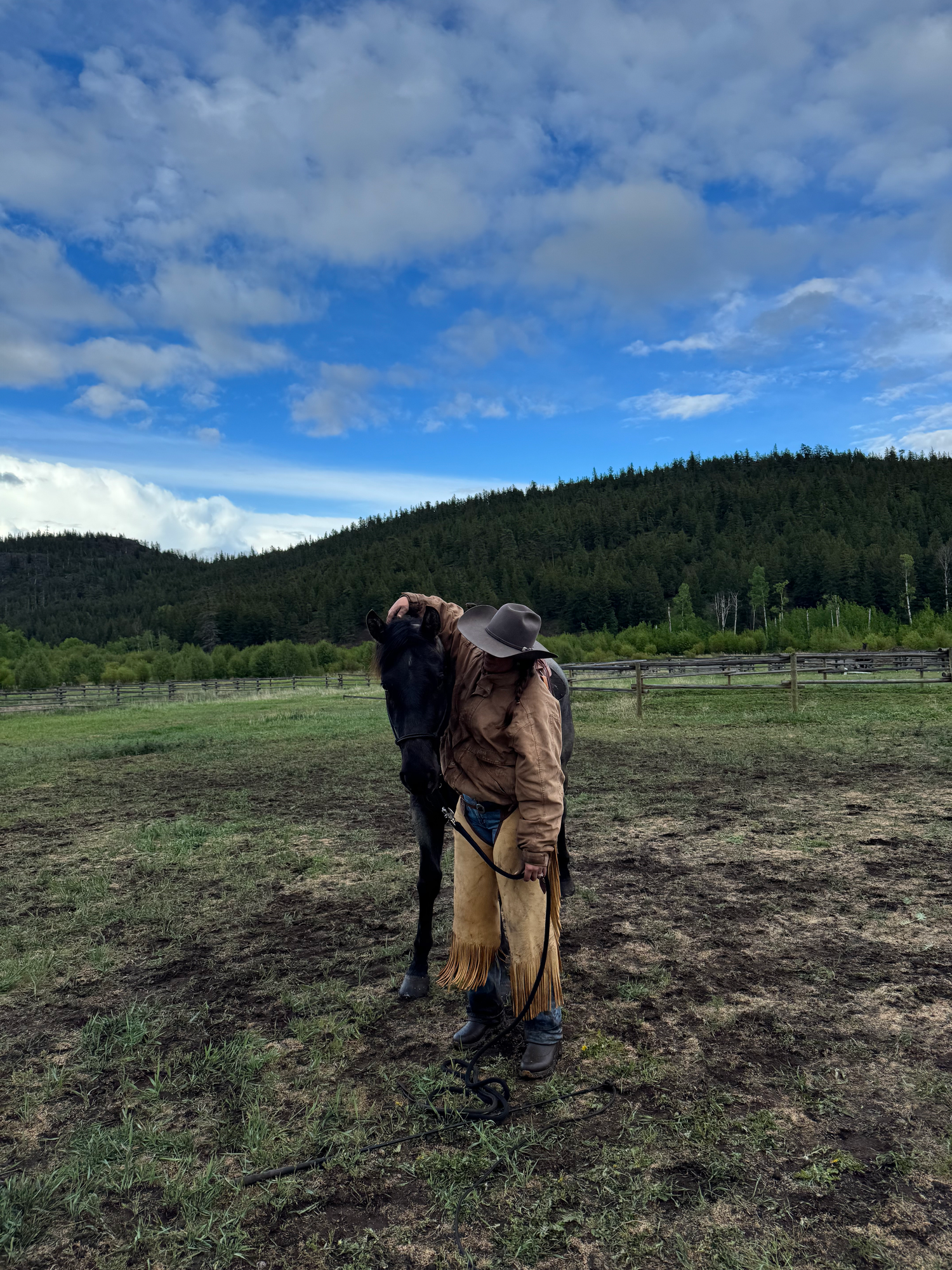
The Weight You Choose to Carry - Lessons Riding Home From James Creek Ranch
By: Madeline Fedora
As the dust settles at James Creek Ranch, I find myself in a state of processing—almost a daze from the flood of new information. I feel lifted with motivation while still grounded with all ten toes. My body is tired in the best way, worn from the miles I put in stepping toward goals that once felt far beyond arm’s reach. Now, those goals have a visible path. A path Jonathan Field rode out on horseback with a chainsaw to clear—cutting through brush and fallen trees so riders like me could finally trot forward with an end in sight.
The moment your boots hit JC Ranch, there’s an atmospheric shift in the air—literally, as the weather changes by the hour, and figuratively, as something inside you changes too. The ranch feels like a portal, drawing in cowgirls and cowboys devoted to becoming better for their horses. Time spent at a JF clinic surpasses simply working on horsemanship; it revitalizes your mindset. The experience humbles you, resets you, and completely shakes what you thought you already knew.
Surrounded by mountains, listening to the creek move steadily over stone, and catching flashes of mountain bluebirds against the landscape, you become centered. Another world unfolds there—one stripped down to what matters most: you and your horse. No distractions. No noise. No service. There is no other place, and no other teacher, that fosters such intention.
The horse trailer creaked over the cattle guard as the kitchen house cabin bloomed into view. After twelve hours on the road, the warmth of the rustic log cabin wrapped around my soul while my bed waited inside. The horses stood heightened in their new environment, nostrils flaring with fresh mountain air that wound through the greenery surrounding us. I put my two colts in their pens as they settled down with the sun.
The next five days were not for the faint of heart—because heart is exactly what they demanded. Grace and grit were what carried you through the lessons, what convinced you to stand in sleeting hail and gear up anyway. Grace and grit were what taught you to meet the horse that showed up for you that day, not the horse you wished for yesterday or hoped for tomorrow. An ease settles into you when you realize the past and future are irrelevant. All that exists is what is. You can't chase what you desire, you have to live it.
There’s a moment at camp when it clicks: perhaps these lessons are shaping who I am becoming as a person first, a horsewoman second. And maybe—just maybe—if I can become steady enough within myself, I might earn the privilege of truly playing with an animal that owes me nothing: the horse.
The teachings of the JF program carry an accountability that wraps around you tightly. Who am I to ask so much of a horse when I am not yet fit myself? To become a leader and a worthy partner, it becomes necessary to leave behind the unnecessary. The stories, the justifications, the ego—all of it has to be loosened from your clenched fist. If you cannot release it, you are not ready.
The emotional fitness required to understand that horsemanship starts with you, while also having nothing to do with you, is uncanny. The mental toughness required to begin again and again on foundation work—and to recognize that restarting is not failure but an honour—is profound. Horses do not care about your excuses; they respond only to what is true in the moment.
This past week, I poured every ounce of try and resilience I had into my horses, and they answered in return. One colt had his first true ride under saddle, while the other experienced his first saddling. Timing, feel, assertiveness, presence, and repetition shaped beautiful changes in both of them. Watching that evolution unfold felt less like forcing progress and more like learning to truly observe what was happening in front of me, instead of reacting to what I hoped was there.
Now, sitting back at home, I reflect in awe—but also with a new weight on my shoulders. A weight that I place upon myself. The clinic may be over, but the real work begins here. It is now my responsibility, as the student and as the horsewoman, to keep the momentum moving forward. To stay honest. To stay soft where I need softness and firm where I need firmness. To keep showing up for the horse with intention knowing they don’t need to show up for me at all.
If I could offer advice to anyone heading to a clinic, it would be this: be quiet. Listen deeply. Engage fully. Become the most absorbent sponge possible. Complacency is what kills progress. Because horsemanship is never just about horses. It’s about learning to clear the brush within yourself so that you and your horse are left with a clear canvas—one where you can create art together through feel, trust, and understanding.
